
The Rich History of Fireplaces and Their Styles Through the Ages
Essential human needs are simple. We require food, water, and shelter for survival, and fire has long played an integral and supportive role in this equation. The history of fireplaces and their styles dates back hundreds of thousands of years to when humans first started using fire for heat and cooking. Across cultures, fireplace styles have reflected the materials, fuels, and architecture available in each era.
Fireplaces changed considerably from the Stone Age to the Medieval Era to 19th century fireplace designs to modern home additions. It’s also why the question “When were fireplaces invented?” can have different answers depending on whether you mean early hearths, built fire pits, or fully vented chimney fireplaces.
Whether you appreciate traditional or contemporary styles, Old World Stoneworks has beautiful cast stone fireplace mantels that incorporate many classic features from historic designs with modern sensibility.
Ancient Origins of Fireplaces
When were fireplaces invented and how have they changed through the ages? The earliest known Stone Age fireplace examples date back nearly 800,000 years, while cooking with fire could go back as far as 1.5 million. In many early settlements, the hearth wasn’t just functional—it helped define the home’s gathering space.
Hearths grew to represent not only cooking but also socialization and the expansion of communal groups. As human society became more complex, groups of hunter-gatherers settled and took up agriculture, and homes and communities became fixed.
In the Medieval Era, fireplaces and hearths evolved along with changing architecture. The history of stonemasonry tells us that fireplaces changed as builders erected structures like castles and larger homes equipped with chimneys to draw smoke up and out rather than have open fire pits in the center of a room.
Fireplace Evolution from the 1600s to Early 1900s
Medieval fireplaces offered significant functional improvements over previous open hearths. Minor improvements continued over the centuries, particularly as new fuel types and heat sources developed.
However, at this point in the history of fireplaces and their styles, a focus on aesthetics became more pronounced. From the open recesses of the 1600s to early American fireplaces to the smaller, more decorative fireplaces of the 20th century, how have fireplaces changed over the last several hundred years? This is where the history of fireplaces becomes as much about craftsmanship and taste as it is about heat.
1600s Fireplaces
Fireplaces of the 1600s were much like those of previous centuries, with cavernous openings large enough to walk into. They were used for cooking and heating, with chimneys venting to the exterior.
The biggest adjustment to the 1600s fireplace came in the form of updated ventilation engineering. These changes helped set the stage for more refined, room-centered fireplaces rather than purely utilitarian hearths.
Louis Savot, an architect best known for his role in the construction of the Louvre in Paris, designed a system that employed vents under the hearth to draw air into the firebox, as well as a vent in the mantel to discharge air, improving airflow and function.
1700s Fireplaces
U.S. Colonial homes were often heated with multiple fireplaces feeding into large, central chimneys. Traditional wood-burning fireplaces were not terribly efficient, with some of the heat escaping through the chimney. A large 1700s fireplace might also introduce a lot of smoke into living areas and pose a risk for house fires.
In 1742, Benjamin Franklin invented the Franklin stove, a cast iron furnace meant to radiate heat in all directions for more effective heating.
While the cast iron successfully absorbed and radiated heat, a flue positioned at the bottom of the stove hindered proper airflow and reduced efficiency. As a result, the original design was not popular, but later, functional improvements led to the modern wood stoves some people still enjoy today.
1800s Fireplaces
Major shifts occurred in 1800s fireplace construction, function, and style. New fuel sources like coal gained popularity in post-Civil War America, with iron stoves and stove pipes providing radiant heating throughout the home without the need for expansive chimneys. Decorative mantels of the time often served as backdrops for coal stoves.
The dawning of the Victorian Era spurred a shift in design styles as well. Cast iron was not only a practical choice for fireboxes, but it also offered extensive potential for intricate ornamentation popular in this era, particularly for grates, surrounds, and other visible structures. For many homeowners today, this layered ornamentation is the hallmark of an old school fireplace aesthetic.
Smaller fireplaces and stoves became a fixture of social gathering spots like parlors, and ornamentations like elaborate mantelpieces, carvings, and tiles were adopted.
Early 1900s Fireplaces
The 20th century saw the advent of major changes in home heating, including furnaces and central air. However, the early-1900s fireplace remained important for practical and social purposes.
Designs of the time tended to feature smaller hearths and masonry fireboxes with millwork mantels. Decorative (non-heating) fireplaces were adopted as other heat sources gained popularity. In some cases, stoves were simply placed in front of existing fireplaces.
Modern Trends in Fireplace Design
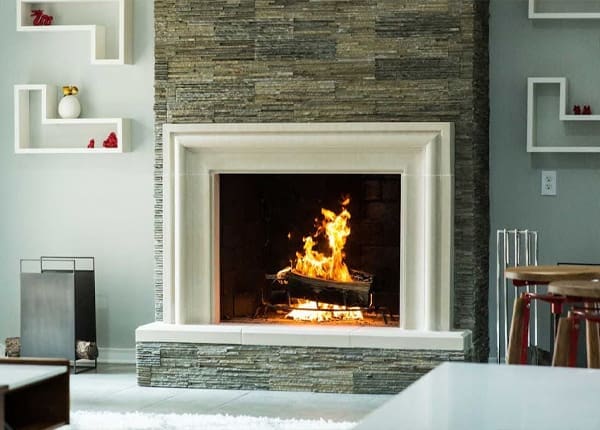
Today, there are many options for fireplace design, including traditional and merely decorative styles. Fireplaces may use fuels like wood or gas, but they can also be electric, providing energy efficiency with sleek, contemporary styling. Modern fireplace styles often borrow historic proportions, especially around the mantel and surround—then simplify the detailing for a cleaner look.
Maybe you like the simple elegance of a midcentury modern fireplace or the minimalist appearance of an electric insert. Whatever your preferred style, you can transform a traditional fireplace and hearth to suit modern aesthetics or install something new to create a focal point in any room.
Old World Stoneworks’ Commitment to Fireplace Craftsmanship
Whether your home style is classic or contemporary, there’s no shortage of options for customized fireplace mantels that preserve historical fashions while integrating modern trends.
When you understand the history of fireplaces and their styles, you can select the elements that appeal to you and choose a mantel that meets your practical needs and aesthetic preferences. That’s the beauty of studying fireplace styles across time: you can honor tradition while tailoring the final look to your home.
If you’re interested in upgrading an existing fireplace in your home or installing something new, Old World Stoneworks offers an expansive selection of handcrafted stone mantels and fireplaces, along with options to create custom designs. Contact us today!
Our French country mantels capture this Old World elegance. Explore our Tudor-style mantels inspired by this grand era.